Sailing Yacht Galley Solutions — The Superyacht Galley

Sailing Superyacht Galley Solutions: Performance and Stability at Sea

A sailing superyacht galley faces a set of design and specification challenges that distinguish it from motor yacht applications in almost every dimension. The heel angle, seakeeping behaviour and motion characteristics of a sailing vessel in passage are fundamentally different from a motor yacht's movement characteristics — and every element of the galley design, from the layout to the equipment specification, must account for these differences.

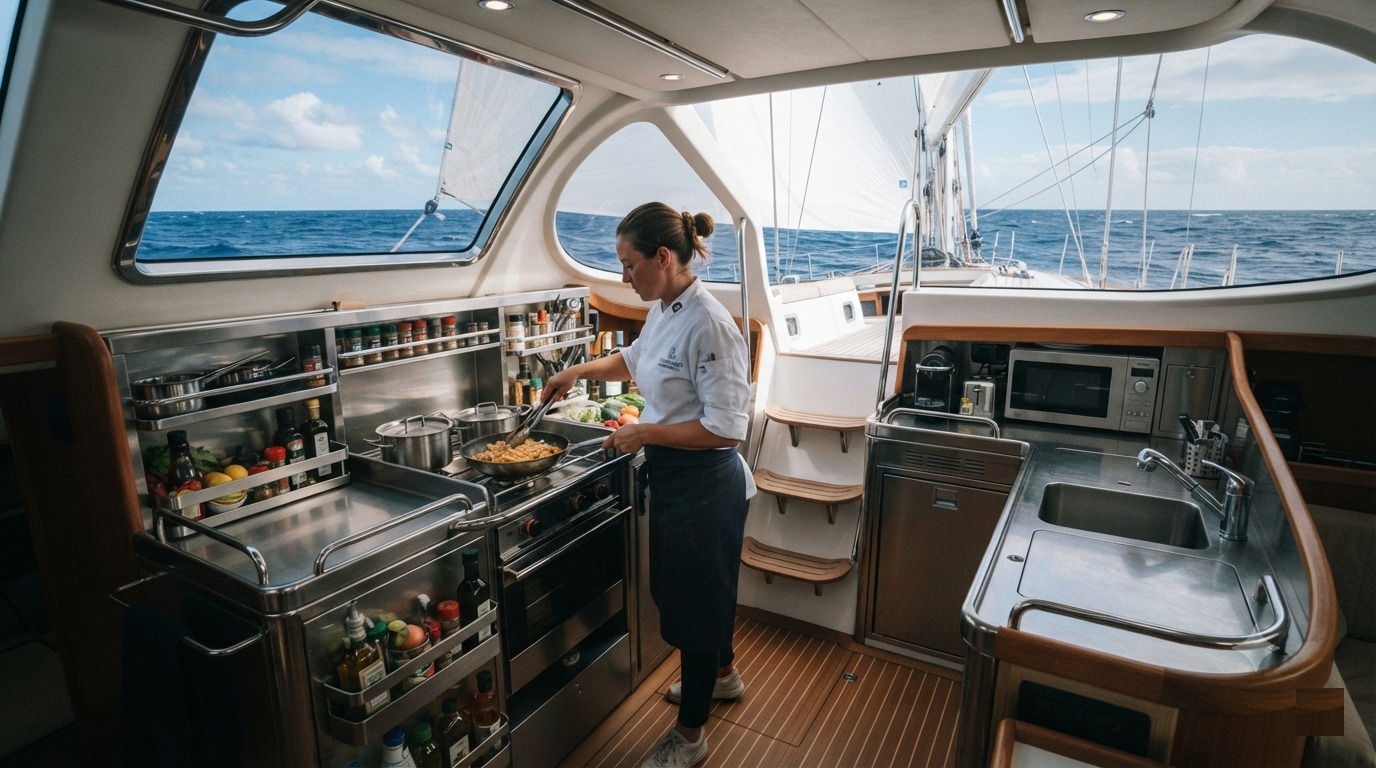
On a sailing superyacht in serious passage-making conditions, the chef operates in a space that may be heeled at 15 to 25 degrees and in which the vessel may roll, pitch and yaw simultaneously. Equipment that is perfectly stable on a motor yacht becomes a hazard in these conditions if not designed and secured for the marine environment. The galley layout itself must work as effectively heeled to port as to starboard, and critically, the chef must be able to work safely in these conditions without having to brace themselves against the motion with both hands.

Safety-First Design for the Sailing Galley

Safety is the primary design consideration for a sailing superyacht galley — specifically the safety of the chef and crew operating the galley in seaway conditions. Key design elements that address this include:

  • Structural handholds — integrated at the working height around the entire cooking area, allowing the chef to brace securely with one hand while operating equipment with the other
  • Fiddle rails — raised stainless steel rails on all worktops and shelves to prevent pots, pans and equipment from sliding or falling in a seaway
  • Gimballed cooking platforms — on offshore passage-making sailing vessels, a gimballed cooking range that remains level as the vessel heels is an important safety feature. We specify gimballed ranges from approved marine manufacturers where this is a design priority
  • Secure equipment mounting — every appliance installed in a sailing galley must be mechanically fastened to prevent movement or toppling in seaway conditions

Equipment Selection for Sailing Galleys

Equipment selection for sailing galleys prioritises marine-specific products over commercial kitchen equipment where the difference in motion resistance and moisture tolerance is meaningful. Gimballed ranges, heavy-duty oven latches, secure refrigerator door mechanisms and vibration-resistant components are all relevant to the sailing context in ways that do not apply on motor yachts.

We also consider the heel angle impact on cooking equipment performance — particularly combi ovens, whose heating and moisture systems depend on precise horizontal operation. We verify that equipment specified for sailing galleys operates correctly within the vessel's typical heel range and advise on any operational modifications required when cooking underway.

Frequently Asked Questions: Sailing Superyacht Galley Solutions

What is a gimballed range and when is it needed?+
A gimballed range is a cooking hob or stove mounted in a pivoting frame that allows it to remain approximately level as the vessel heels. This prevents pots from sliding on the cooking surface and ensures the cooking surface itself remains horizontal relative to the pot — preventing uneven cooking from the vessel's angle. Gimballed ranges are most appropriate for offshore passage-making sailing yachts where the vessel heels significantly for extended periods. For sailing superyachts that rarely sail in conditions beyond force 5, a fixed-mount induction cooking surface with fiddle rails may be adequate and is increasingly preferred for its safety advantage over open flame cooking.
Can induction cooking be used on a sailing superyacht?+
Yes, and it is increasingly specified on sailing superyachts. Induction cooking eliminates open flame from the galley — a significant safety advantage on a sailing vessel where the combination of heel, motion and gas presents higher fire risk than on a relatively stable motor yacht. Induction cooking surfaces can be mounted at a slight athwartship angle to allow pots to remain stable in the most common heel direction, and with appropriate fiddle rails are practical for most passage-making conditions. The primary constraint on induction cooking for sailing vessels is electrical supply — the generator must be sized to support the induction load.
How should refrigerator doors be specified for a sailing galley?+
Refrigerator doors on a sailing vessel must be secured with positive-latching mechanisms that hold the door closed against the forces that a heeled or rolling vessel exerts on it. Standard undercounter refrigerators with spring-loaded magnetic doors are not adequate for offshore passage use — the door can swing open on a tack or in heavy seas, spilling contents and losing the cold in the cabinet. Marine-rated refrigeration with secure mechanical latches is required. We specify refrigeration appropriate for the vessel's intended use — marine-rated units for passage-making sailing vessels, commercial units with latch modifications for yachts that do not frequently sail in extreme conditions.
Does a sailing galley need handholds throughout?+
Yes. The most important safety feature in a sailing galley is a comprehensive network of handholds at working height throughout the space — allowing the chef to move through the galley safely in all conditions without losing contact with a secure handhold. The handholds must be positioned so that there is always at least one within reach from any working position, and they must be structurally secured to the galley structure or hull rather than to cabinetry or joinery. We review handhold placement as part of every sailing galley layout assessment and will recommend additions where coverage is inadequate.
Can a combi oven be used at sea on a sailing vessel?+
A combi oven can be used at sea on a sailing vessel, but its performance may be affected by significant heel angles — the water injection system and steam generation in most combi ovens are calibrated for horizontal operation. Many chefs on sailing superyachts restrict combi oven use to conditions where the vessel is approximately level — at anchor, in protected waters, or in light wind conditions — and rely on range cooking for heeled passage-making. We advise on this at commissioning and provide guidance on which cooking modes are most practical for use underway.
Is LPG or electric cooking safer on a sailing superyacht?+
Electric induction cooking is generally safer than LPG on a sailing vessel. LPG storage and the associated gas installation introduce fire and explosion risk — LPG is heavier than air and can accumulate in bilge spaces if a gas leak occurs. On a sailing vessel where heel can affect the behaviour of gas installations and where the motion may make open flame more hazardous, eliminating LPG reduces risk. Induction cooking eliminates both the storage risk and the open flame. The trade-off is the electrical supply requirement — an induction galley needs a well-sized generator to supply the cooking load.
How is the galley oriented on a sailing superyacht for optimal use when heeled?+
The ideal sailing galley orientation places the main working surfaces and cooking equipment along the centreline or slightly offset to the vessel's most common heel direction, so that when heeled the worktop surface is closest to level. An athwartship (across the vessel) galley orientation is often preferred on sailing vessels, allowing the chef to brace from bulkhead to bulkhead across the vessel's beam. Fore-and-aft galley layouts can also work well with appropriate handhold design. We review the galley orientation in the context of the vessel's sailing characteristics and advise on the most practical arrangement for passage-making use.
What special considerations apply to the sailing galley ventilation system?+
Ventilation on a sailing vessel must function effectively in all conditions — including when the vessel is heeled and when the wind direction varies relative to the vessel heading. Extract ducting and outlet positions must be designed so that the extract system functions in all points of sail without backdraught or extract system failure. We provide ventilation extract volume calculations for sailing galley projects and highlight any ventilation design concerns for the HVAC engineer to address. Inadequate ventilation is a comfort and safety issue in any galley, but particularly on a sailing vessel where the galley may be used in demanding conditions for extended periods.
Abraham Stones
Superyacht Galley Specialist

Abraham Stones has delivered sailing yacht galley solutions for owners, shipyards and management companies worldwide. His 20+ years of hands-on superyacht galley experience ensures every solution is grounded in real operational knowledge.

View full profile →

Discuss Your Project

Tell us about your vessel and requirements. Our team responds to all enquiries within one business day.