
Superyacht Galley Refit & Equipment Upgrade
Planned refit and opportunistic equipment replacement — upgrade your galley performance without unnecessary downtime.
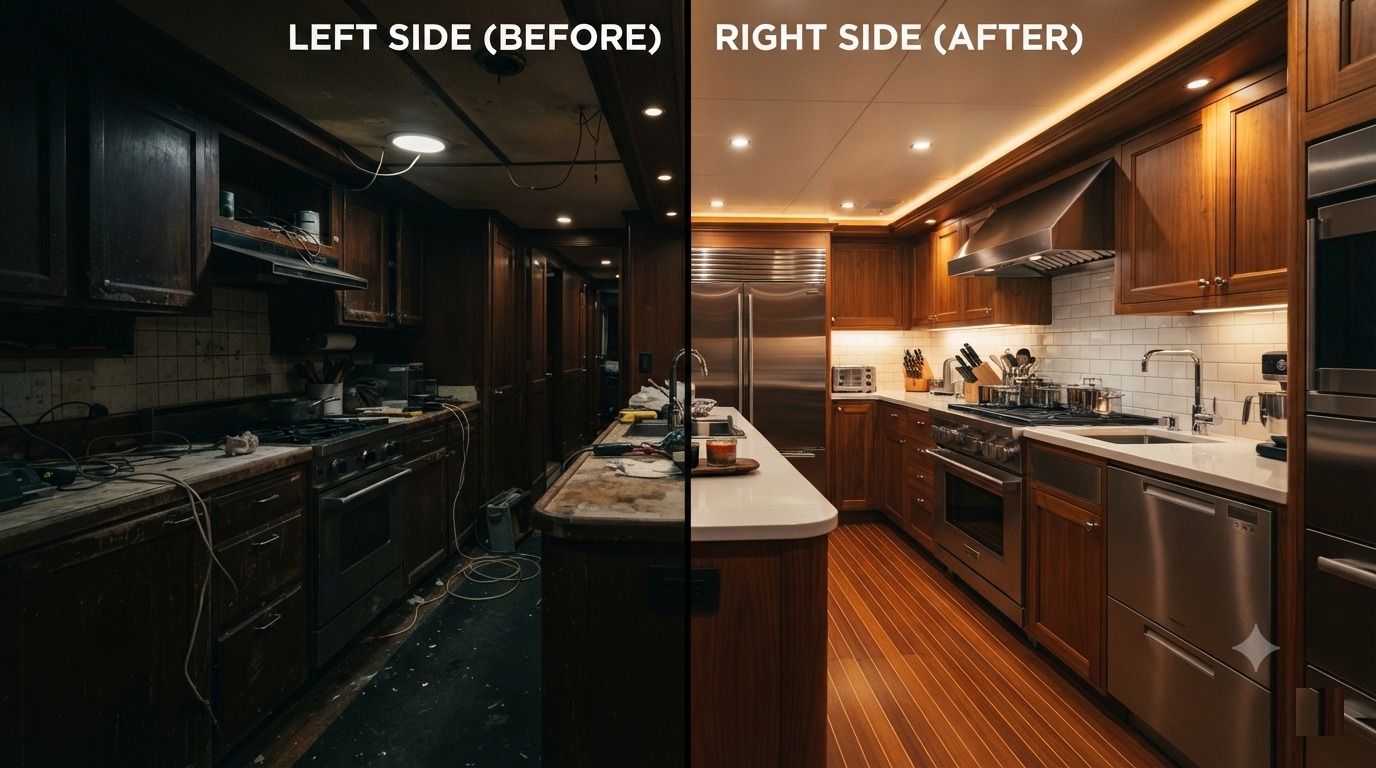
Superyacht Galley Refit: Planning, Specification and Procurement
A superyacht galley refit is fundamentally different from a new build project. Instead of designing from first principles, a refit must work with — and often against — an existing structure. Bulkheads are fixed. Plumbing routes are established. Electrical panels have finite capacity. The objective is to maximise the improvement that can be achieved within the constraints that exist, without creating structural problems that increase cost and duration beyond the project's scope.
Our refit galley work ranges from complete galley strip-outs and rebuilds through to targeted equipment replacements within an existing fitted galley. Each project begins with a thorough assessment of the existing installation — identifying what can be retained, what should be replaced for performance or safety reasons, and what changes to the layout are achievable within the structural envelope.
Why Galleys Are Often Prioritised in Refit
In the superyacht market, galley refits are driven by several factors that tend to coincide:
- Equipment age — commercial cooking and refrigeration equipment has an operational life of 8 to 15 years in a demanding marine environment. Equipment approaching or beyond this age begins to present reliability and operational risks that justify replacement
- Charter market standards — charter market expectations evolve, and a galley that was appropriate when the vessel was built may no longer meet the standard that charter guests and operators expect
- Change of use — a vessel transitioning from private to charter use, or increasing its charter programme, requires a galley capable of supporting the higher-volume, more demanding cooking programme that charter service demands
- New technology — induction cooking, advanced combi oven technology and intelligent refrigeration systems represent material improvements over equipment installed a decade or more ago
Our Refit Galley Process
We manage the refit galley process from survey through to commissioning. Our approach follows a structured sequence that minimises surprises and maintains programme discipline:
Survey and assessment — we conduct a detailed survey of the existing galley installation, assessing all equipment, services and structural elements. We produce a condition report with recommendations for retention, replacement and modification.
Brief development — working with the captain and owner, we define the brief for the refit galley — what should be improved, what the new galley should achieve and what constraints (budget, programme, structural) apply.
Specification — we develop the complete equipment specification for the refit, including all modifications required to existing services and structure to accommodate the new installation.
Procurement and coordination — we order all equipment, coordinate delivery to the yard and work with the yard's engineering team to manage the installation sequence.
Commissioning — we commission all new equipment and provide crew training at handover.
Frequently Asked Questions: Superyacht Galley Refit
How long does a galley refit typically take?+
How do we decide what equipment to replace versus retain?+
Can the galley layout be changed in a refit?+
Which shipyard should we use for a galley refit?+
Can we upgrade to induction cooking in a refit?+
How do we manage the galley refit if the vessel is in active charter?+
What happens to the old equipment?+
Do you manage the full galley refit project or just the equipment supply?+
Related Services
Discuss Your Project
Tell us about your vessel and requirements. Our team responds to all enquiries within one business day.