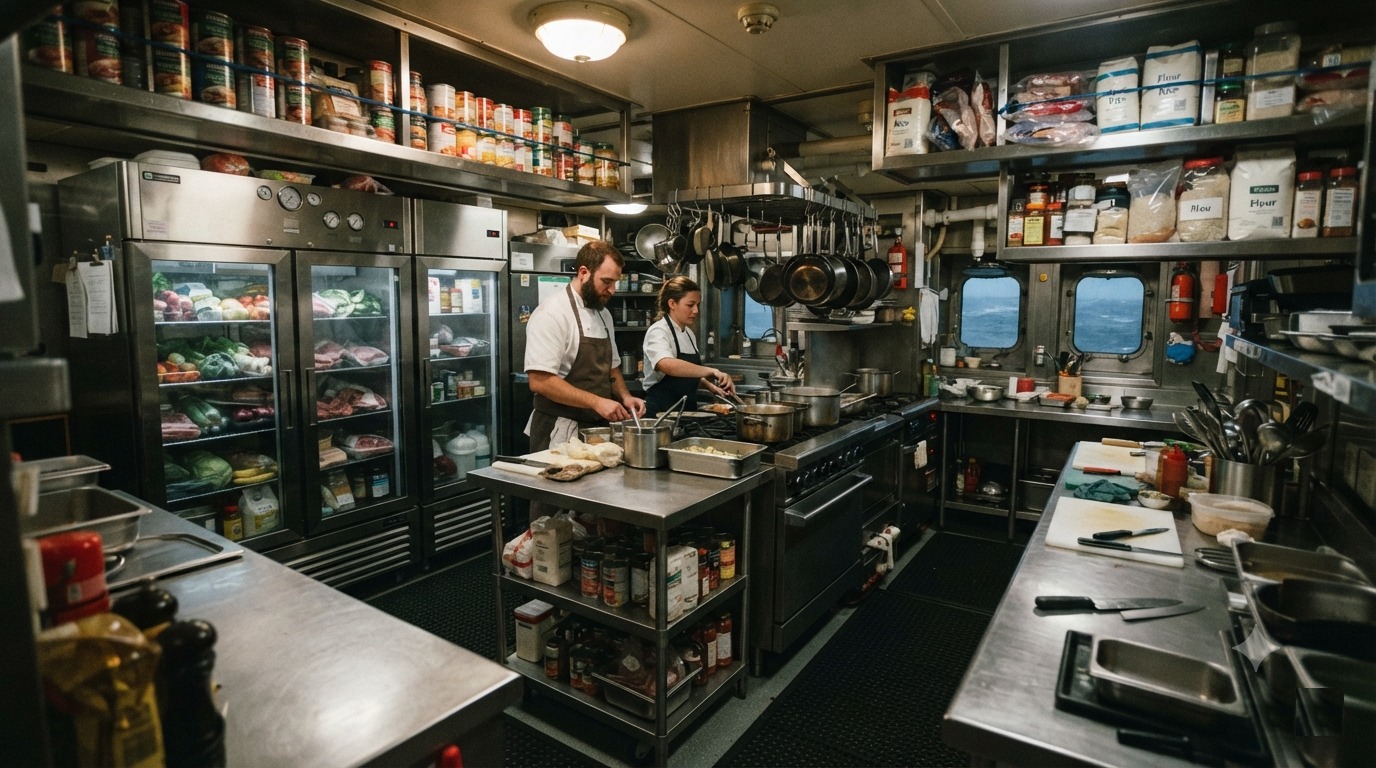
Explorer Superyacht Galley Solutions: Designed for Remote Operations
Explorer superyachts present the most demanding galley specification challenge in the sector. These vessels — purpose-built for extended, long-range passages to remote and challenging destinations — require a galley that can support professional culinary service for guests and crew across passages of weeks or months, often far from provisioning ports and without access to specialist service support.
Where a Mediterranean charter yacht can provision twice weekly and call a service engineer the same afternoon if an appliance fails, an explorer in the Southern Ocean or Arctic may go weeks between provisioning opportunities, and service support is not an option. The galley equipment selected for an explorer superyacht must therefore be exceptionally reliable, repairable aboard with minimal specialist tools and parts, and capable of operating in the extreme ambient temperature ranges that high-latitude destinations present.
Provisioning for Extended Passages
The most important galley planning challenge on an explorer superyacht is provision storage capacity. Long-range passages require the vessel to carry provisions for the entire voyage — not just for the intended passage duration, but with a meaningful reserve for delays, extended stays and unexpected changes to the programme. For a passage of 14 days with 12 people aboard (guests and crew), provisioning runs to several hundred kilograms of fresh, chilled and dry stores.
We calculate provision storage requirements for explorer vessels based on:
- Passage duration and crew — total person-days at sea between provisioning opportunities
- Provisioning quality — the quality and variety of food available at destination ports, which determines how much must be brought from the departure port
- Reserve provision — additional margin for delays, programme extensions and emergencies
- Preservation methods — vacuum sealing, controlled-atmosphere storage and other techniques that extend the life of fresh produce
Redundancy and Reliability
On an explorer superyacht, galley equipment redundancy is not a luxury — it is an operational necessity. We specify critical systems with built-in redundancy: two combi ovens rather than one; multiple independent refrigeration circuits; duplicate critical cooking zones. This approach ensures that a single equipment failure does not force the chef to significantly compromise the culinary programme while a replacement is sourced from the nearest available supplier — which may be weeks away.
Equipment Serviceability
We select equipment for explorer galleys with serviceability in mind — preferring brands with well-documented service procedures, accessible internal components and robust spare parts availability. We also specify a comprehensive onboard spare parts kit for every critical appliance, including common-failure items such as heating elements, pump impellers, door seals and temperature sensors. A well-stocked spare parts kit turns a potentially voyage-ending equipment failure into an afternoon repair.
Frequently Asked Questions: Explorer Superyacht Galley Solutions
How do we calculate provision storage for an Arctic or Antarctic passage?+
For high-latitude explorer passages, provision storage calculation must account for passage duration, crew and guest count, the limited quality and availability of provisions at destination ports, and a meaningful reserve. For a two-week Southern Ocean passage with 20 people aboard, total provision weight may be 400 to 600kg of fresh, chilled and frozen stores, plus dry goods for the full passage duration. We calculate specific storage requirements for each planned voyage and specify the refrigeration and freezer capacity to match. For expedition-grade vessels, dedicated provision stores separate from the galley refrigeration are typically required.
What redundancy should an explorer galley have?+
We recommend a minimum of two combi ovens as the primary cooking units — one primary and one secondary — so that an oven failure does not compromise the vessel's ability to cook for the full complement. Refrigeration should be split across at least two independent circuits, so that a compressor failure affects only part of the cold storage capacity. Critical cooking zones on the range should have backup capability either through the combi oven or a separate cooking surface. We assess the redundancy requirements for each vessel based on its planned itinerary and the consequences of equipment failure in the destination area.
What spare parts should an explorer yacht carry for galley equipment?+
We provide a specific recommended spare parts list for every critical appliance in the galley. Common items include: combi oven door gaskets, wash arm nozzles and heating elements; refrigeration compressor relay switches, fan motors and thermostats; dishwasher pump impellers, door seals and heating elements; range ignition units and burner parts (if gas). The complete spare parts kit for a fully equipped explorer galley is compact and relatively low-cost to carry but can be the difference between a manageable repair and a voyage-disrupting failure in a remote location.
Can galley equipment operate in very low ambient temperatures?+
Most professional cooking and refrigeration equipment is rated for ambient temperatures above approximately 5°C. In very cold ambient conditions — such as a galley that has cooled significantly during a night in Arctic waters — some equipment may require a warm-up period before operating correctly. Refrigeration equipment is particularly sensitive to very low ambient temperatures, as the compressor control logic is typically designed for the temperature range used in normal professional environments. We advise on operating protocols for cold-ambient conditions and, where necessary, specify equipment rated for extended operating temperature ranges.
What food preservation techniques extend provision life on long passages?+
Vacuum packing is the most effective and widely used method for extending the life of fresh and cooked provisions — removing oxygen significantly extends the shelf life of meat, fish, cheese and prepared foods. We specify chamber vacuum packers for explorer yacht galleys as standard. Blast chilling cooked food before cold storage slows bacterial growth and extends the useful life of prepared dishes. For very long passages, we advise on the most effective sequence of provision use — consuming the most perishable items first and preserving longer-life items for later in the voyage. Controlled atmosphere storage bags for fresh produce are also effective for extending fruit and vegetable life.
How do we provision in remote locations with limited food supply?+
The most reliable approach for explorer passages is to depart with sufficient provisions for the full intended voyage — treating destination port provisioning as an opportunity to supplement supplies with local fresh produce rather than a primary supply point. This requires larger provision storage capacity and more thorough advance planning than short-range voyages demand. We advise on menu planning approaches that make effective use of a broad range of provision types — including preserved, vacuum-packed and canned items — without compromising the quality of the culinary experience for guests.
Should an explorer galley have a fish/game preparation area?+
For explorer vessels where fishing or game hunting is a significant activity — particularly in Alaska, Norway and remote Pacific destinations — dedicated fish and game preparation facilities improve the galley's ability to handle fresh catches efficiently. This typically includes a dedicated stainless steel preparation surface, proximity to an ice maker for rapid chilling, and convenient access to cold storage with the capacity to hold a significant catch. We design fish preparation areas as part of the overall galley layout for explorer vessels where this is a relevant operational requirement.
How is the crew galley on an explorer superyacht typically specified?+
Explorer superyachts with large crew complements — 15 to 25 crew is typical on vessels over 60 metres — often require a separate crew mess with independent cooking facilities. We specify the crew galley alongside the main galley, ensuring the crew has adequate cooking, cold storage and dining facilities for their own meals without competing for the main galley's resources during guest service. The crew galley specification is typically simpler than the main galley — a commercial range, undercounter refrigerators, a microwave and a domestic-grade dishwasher are often sufficient for crew use.