Espresso Coffee on a Superyacht: The Complete Guide
From barista-grade espresso machines to deck coffee stations — how to select, specify and operate coffee systems that meet the highest onboard standards.
Coffee service is one of the most personal touchpoints in any superyacht guest experience. Whether you are specifying a new build or reviewing a refit, getting the coffee systems right — from the machine format to the filtration, the service workflow to the cup — has an outsized impact on how the vessel is perceived. This guide covers everything involved in selecting, installing and operating espresso and coffee systems aboard.
Choosing the Right Coffee System Format
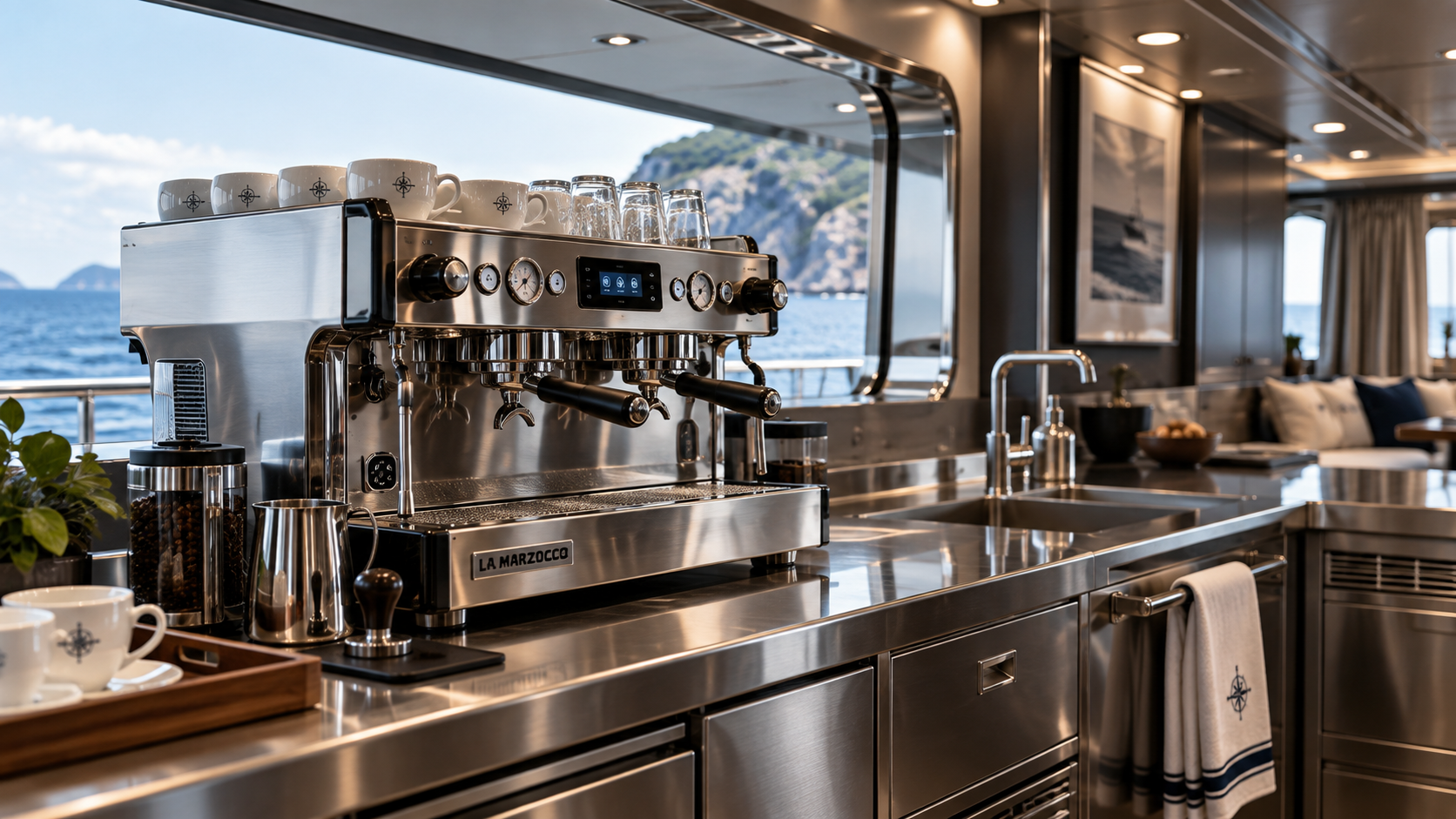
The answer depends on crew size, service expectations and available power. At the top end of the market, a traditional two-group espresso machine from La Marzocco, Nuova Simonelli or Victoria Arduino delivers café-quality espresso coffee on a yacht — but it requires a trained barista and a stable 3-phase supply. On vessels where the stewardess is also operating the helm, a super-automatic machine covering grinding, dosing and extraction in one touch is a more practical specification.
Traditional Espresso Machines
A two-group commercial machine is the benchmark specification for large yachts running structured service. It gives the most control over extraction parameters and produces the cleanest espresso. Heat-exchange boilers or dual-boiler systems allow simultaneous steam and brew without temperature compromise — important when you are serving four tables at anchor. These machines require a dedicated filtered water circuit, a 20A–32A supply, and a disciplined cleaning routine.
Super-Automatic Machines
Machines from Jura, WMF, Thermoplan and De'Longhi Professional handle the full bean-to-cup cycle without intervention. The consistency is slightly lower than a skilled barista, but the workflow is reliable and training requirements are minimal. These are the most-specified format for yacht deck espresso coffee service — compact units can be installed in beach club pantries, sun deck service stations and tender vessels where power and space are limited.
Capsule and Pod Systems
Nespresso Professional, Illy and similar pod systems are widely used in crew areas, VIP cabins and tender specifications. They produce a consistent result with no mess, no maintenance, and pods available in most global ports. The environmental consideration of single-use capsules is increasingly relevant to charter guests; recyclable capsule programmes from major brands are available as a specification point.
Filter and Cold Brew Stations
A Bravilor, Marco or Bunn batch brewer allows pre-prepared filter coffee to be served through insulated carafes during breakfast service without pulling individual shots. Cold brew systems — pre-steeped in the galley refrigeration — are a low-effort way to serve guests who prefer a smoother, lower-acid cup, particularly in warmer cruising grounds.
Coffee Pots and Service Equipment for Boats
The coffee pots for boats differ from domestic options in three ways: thermal retention, stability and durability. A vacuum-insulated stainless carafe holds temperature for three to four hours without a heat source — essential when service runs across a deck that spans 30 metres. Zojirushi, Frieling and Alfi produce marine-appropriate options. Glass carafes are not suitable for yacht service. Non-tipping, weighted bases are preferable in any sea state above flat calm.
Cups should be bone china — it retains heat longer than earthenware and signals quality to the guest. Demitasse, lungo and flat white cups should all be aboard in a charter specification. A properly warmed cup is not a luxury detail; it is a technical requirement for correct espresso service.
Yacht Deck Espresso Coffee Service
Serving espresso coffee on a yacht deck introduces variables that a shoreside café never encounters: wind that cools the cup before it reaches the guest, a moving surface that challenges tray balance, and a potentially limited power supply. A dedicated deck coffee station — installed at the sun deck service pantry or aft deck drinks station — allows the steward to pull shots without the round trip to the galley.
Compact 15-bar pump machines running on 230V or 12/24V DC are available for this application. Some specifications include a dedicated water pressurisation vessel for the deck unit, eliminating the need for a direct plumb connection. The machine should be weather-resistant (IP44 minimum) and have a drip tray that drains positively without spilling on movement.
Water Filtration for Espresso
This is the detail most commonly overlooked in a yacht galley coffee specification. Desalinated or reverse-osmosis water — the standard aboard most superyachts — has a TDS near zero. Espresso extracts mineral compounds from the coffee as much as it extracts flavour compounds; very pure water produces a flat, under-extracted cup regardless of how well the machine is calibrated. A remineralisation cartridge fitted to the coffee supply line restores the mineral balance. Everpure, BWT and Purity are the most commonly specified filtration systems for this application.
Power Planning
A commercial two-group machine draws 3.5–5.5 kW at element activation — typically brief, but it must be accounted for in the load plan. Super-automatics draw 1.2–2.5 kW. If coffee service coincides with other high-draw appliances (combi oven, induction suite), the generator load must accommodate the aggregate. Marine-rated machines with dual-voltage configurations (220–240V / 110–120V, 50/60Hz) are essential for yachts crossing between North American and European electrical supply zones.
Maintenance and Serviceability
Choose machines for which spare parts and consumables — group head gaskets, shower screens, boiler elements, cleaning tablets, descaling chemicals — are available through marine chandleries or international courier. La Marzocco, Jura and Nuova Simonelli all have global service networks. Document the cleaning schedule in the vessel's maintenance log: backflushing, group cleaning, grinder calibration, and boiler descaling should all have defined intervals.
Key Brands for Superyacht Coffee Systems
- La Marzocco — flagship commercial espresso machines, specified on the world's largest yachts
- Nuova Simonelli — widely installed on large motor yachts, strong service network
- Jura — super-automatic reliability, preferred for owner-operated and secondary service points
- WMF — German engineering, popular in charter fleet specifications
- Nespresso Professional — capsule system for tender vessels, crew areas and beach clubs
- Franke — integrated professional systems for large yacht pantry installations
Related Services
Written by Abraham Stones, drawing on 20+ years of superyacht galley design, specification and procurement experience. All content reflects real-world project knowledge from vessels of every size.
View full profile →Apply This to Your Vessel
Every vessel is different. Speak with our specialist team to apply this guidance to your specific project — we respond to all enquiries within one business day.


